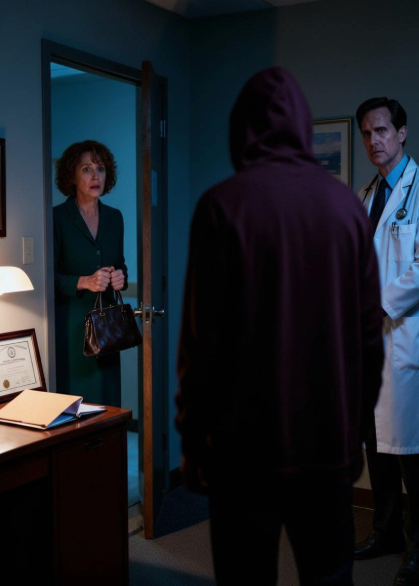
“Emily… you need to come to my office right now. And please—don’t tell anyone you’re coming.”
The urgency sliced through my grief.
“Is something wrong?” I whispered.
He drew a sharp breath. “Just come. Immediately.”
The drive to the clinic felt detached from reality, as if my body moved on autopilot while my mind remained frozen in the stillness of the cemetery. When I arrived, the parking lot was empty except for his car. The building stood dark, save for the light glowing in his office window.
My legs trembled as I climbed the stairs. I knocked once. The door opened at once.
Dr. Clarke looked exhausted—ashen, eyes red, like he hadn’t slept. But my stomach tightened at the sight of the woman beside him. She was tall, severe, dressed in a gray suit, studying me with professional detachment rather than sympathy.
“Emily,” Dr. Clarke said quietly, “this is Special Agent Nora Hayes.”
Cold swept through me.
Agent Hayes stepped forward. “Mrs. Whitmore, please sit down. What we’re about to discuss may be very difficult.”
I looked between them, confusion pressing down on my chest.
“My daughter d:ied in a car ac:cident,” I said flatly, repeating the words as if they were the only thing keeping me upright. “That’s what they told me.”
Agent Hayes exchanged a look with Dr. Clarke—heavy with tension, fear, and something else that made my spine stiffen.
“Mrs. Whitmore,” she said gently, “there were findings on Lily’s body that don’t align with the official report.”
My breath caught. “What are you saying?”
Dr. Clarke swallowed, guilt filling his eyes.
“I received the preliminary autopsy results today. There are… discrepancies. And one of them—”
His voice faltered.
“—is something I should have told you years ago.”
And with those words, the ground beneath my life began to fracture.
I clutched the arms of the chair so hard my nails left half-moon marks in the fabric.
“What do you mean—inconsistencies?”
Agent Hayes opened a folder and slid a photograph across the table. It was an autopsy image—one I was never meant to see. The air left my lungs.
“This,” she said, indicating the bruising along Lily’s ribs, “was not caused by a seat belt or an airbag.”
I shook my head in denial. “No. That can’t be right. The police said—”
“They were given incorrect information,” she cut in gently but firmly. “These injuries indicate restraint. Intentional restraint.”
See more on the next page
Advertisement
